
While residents struggle, Peel Region proposes massive tax hike
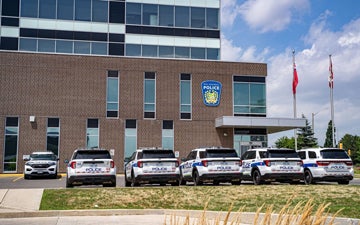
Difficult to understand need for 80% increase in Peel police budget over five years, say property taxpayers representing Brampton, Caledon, and Mississauga
MISSISSAUGA, Dec. 4, 2025 – In the final regional budget before municipal elections next year, it’s clear residents need one thing from their elected officials: relief.
They won’t find it in the Region of Peel’s proposed 2026 budget.
The document presented to the council on November 20 includes a 9.2 percent net tax levy increase, and a 7.8 percent hike in the utility rate.
The proposed 9.2 percent budget increase supported by property taxes is only for the Region’s share of the bill, which accounts for a little more than 40 percent of what residential and commercial property owners pay (just under 40 percent goes to the lower-tier municipality, and the remaining 20 percent of the property tax bill is for the provincial education share).
Under the current breakdown, the Region’s proposed 9.2 percent increase represents a 4.2 percent hike in the overall tax bill, not including whatever amounts are added onto it by Brampton, Mississauga and Caledon — when their local budgets are approved — and the province, which has not increased its education portion in more than a decade.
For the average household, this would mean an additional $341 for taxes and utilities: $125 going directly toward the Region’s budget; $141 to Peel’s external agencies (almost all of that, $138, is just for Peel Police); and $75 for utilities.
More than a third of the additional funds required from Peel residents is a result of another significant budget request from Peel Police. For 2026, the force is asking for a 9.9 percent increase to cover operating costs, which will bring the operating budget to approximately $837.3 million, an 81 percent increase from the $462.5 million in 2021.
As residents face crippling cost of living increases, a housing shortage and high unemployment across the GTA, the massive hike in the police budget comes after the force enjoyed a 23.3 percent increase in its total budget this year and 14 percent the year before, well over a quarter of a billion dollars extra in just three years. The police services board and regional councillors have failed to launch external audits of the police budgets, which were described as an “utter failure of governance” by Alok Mukherjee, the former chair of Toronto’s police board.
The rest of the regional tax increases, along with stiff utility rate hikes have piled on added layers of frustration for taxpayers forced to stretch every dollar, while regional spending goes through the roof.
"Ongoing large tax increases are not sustainable and must stop. The region and the police must find efficiencies and ways to trim their budgets," Sue Shanly, Chair of the Mississauga Residents' Association Network (MIRANET) said during the November 27 Peel budget meeting. "Whilst we have always supported an effective and efficient regional police force, it is difficult to understand the necessity of an over 80 percent increase in the police budget in the past five years, from 2020 to 2025. While residents of Mississauga are struggling."
Her words were echoed by Khalid Shuja, a Mississauga resident, who highlighted the financial challenges his family is going through and asked council to cut taxes.
"I start with a quiet question that bothers me every night: when you gather with your loved ones around the kitchen table to map out your family budget, how do you make it fit?" he said. "We all do it; we say no to extras, and we stretch what we have, because no one plans for what they can't afford. How can our departments ask for more? I urge you to send this budget back to the hands that shaped it, give them a tight timeline and ask them to find a way to have zero tax hikes."
After Shanly’s delegation, Mississauga Councillor Joe Horneck mentioned a shortfall of $10 million in critical services like seniors and public health as a result of provincial underfunding, and asked her whether these services should be covered through the Peel budget.
"If we've got to make up $10 million and the staff assumption is always that we're going to step in and do it. You think that's the right thing to do? Or should we say we're not going to provide that service and it's the province's fault?”
Shanly responded by saying that this is a time when “more serious conversations with the province” should take place. “They really let down the Region of Peel. We can't continue to go down, because it looks like every year our services are going down."
During the council meeting, Brian Gibson, Chief and Director of paramedic services, detailed the challenges paramedics are facing. In 2024, paramedics responded to 148,718 calls, and due to understaffing, 13 ambulances were off the road routinely, and when the demand was for 27 ambulances, only four were responding. The paramedics are seeking a net budget increase from $112.1 million in 2025 to $127.6 million in 2026, a 14 percent jump to hire 43 new paramedics and cover other needs across the department.
Peel’s long-term care homes and Adult Day Services (ADS) are also facing growing service demands, with 3,277 applications waiting for admission into Peel’s 5 long-term care homes and 607 individuals on the waitlist for ADS. Demand will only increase: one in five residents in Peel will be over the age of 65 by 2041. For the upcoming year, a net increase of $5.6 million has been requested, from $56.8 million in net expenditures to $62.4 million next year.
"What are the top priorities for the Region of Peel and for the City of Mississauga?” Mike Harris, a Mississauga resident, asked on behalf of the Applewood Hills and Heights Residents' Association (AHHRA).
"The objective is to get to zero percent and work backwards; start at your top and cut out the bottom things."
During the November 27 meeting, Jaipaul Massey-Singh, the Chief Executive Officer of the Brampton Board of Trade (BBOT), shared alarming statistics from its most recent business confidence index survey, highlighting that 53 percent of business leaders responded that Brampton’s economy has worsened over the past year, outnumbering those who believed it improved by three to one.
Singh advocated to safeguard Peel's already underfunded social service system.
"We urge the Regional Council to ensure the 2026 budget does not inadvertently push businesses into retreat. We cannot control trade decisions, but we can control local circumstances."
The Metamorphosis Network, a collective of more than 100 social service agencies in Peel, released a disturbing report in May last year detailing the $868 million provincial funding shortfall in community service support, along with gaps in funding for healthcare, education, mental health and addictions support.
Brampton Councillor Paul Vicente inquired about discussions between local stakeholders and local MPPs, who could lead efforts inside Queen’s Park to advocate for Peel’s fair share of provincial funding.
Vijay Kumar Singh, manager of policy and government relations at BBOT, responded that at the provincial level, there is “an acknowledgement that there are growing infrastructure challenges and population challenges in Peel and more acutely in Brampton, and that there needs to be some level of additional support.”
Singh, along the same lines, said that while there is an acknowledgement and awareness of the data shared by Metamorphosis, there is a lack of action.
"They will always say they're looking for solutions," he said. "But we haven't seen the idea that turned into action just yet."
Vicente said provincial officials have questioned the size of Peel’s funding gap.
"Metamorphosis is claiming a number around the area of 800 million in terms of the deficit in funding for the Region of Peel, and the province is saying, ‘how is that even possible? It can't be’. And so we've been working together." It’s unclear what work he was referring to, or who is doing the work.
Peel’s Regional budget is divided into two streams: the operating budget is $4.3 billion; and the capital budget is $1.2 billion. An additional $1.8 billion will be needed for the proposed capital budget that covers utilities.
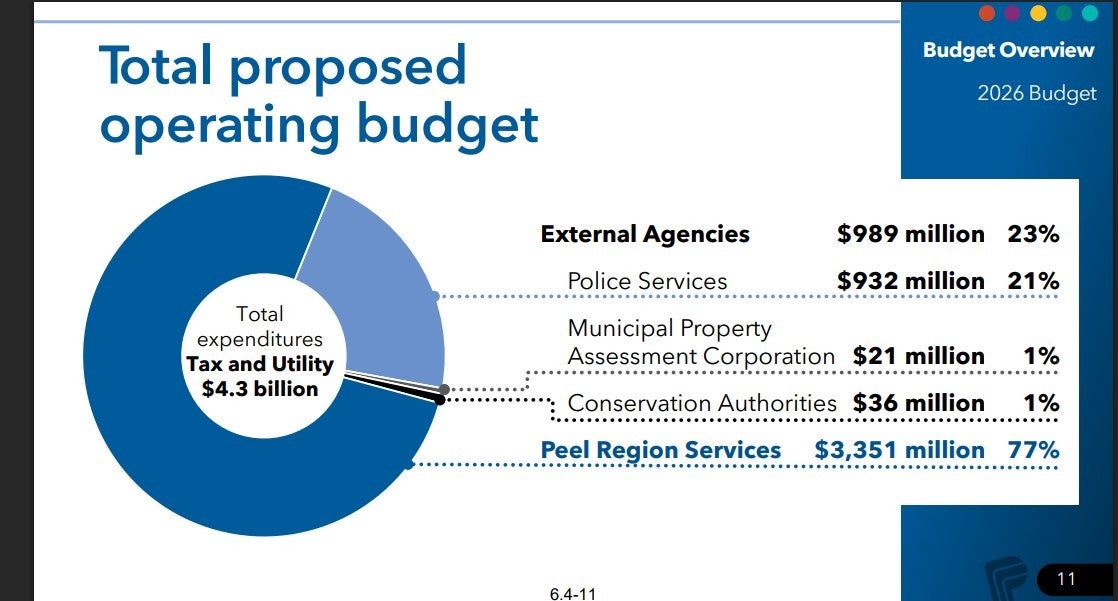 |
Peel Region total proposed operating budget. CLICK TO ENLARGE. |
The proposed capital budget for utilities includes major projects, such as $260 million for the Upper West sanitary trunk sewer diversion, $144.8 million for water main construction on Derry Road East, $130 million for the Williams Parkway sub-transmission main, $102 million for the Clarkson water resource recovery facility expansion and $55 million for the Macville booster pumping station.
The region proposes to invest $44 million to support homeless encampment transitional housing, $3.2 million to expand TransHelp ridership, and $29.1 million for Peel’s integrated waste management and curing facility.
 |
Peel Region 2026 Capital Budget. CLICK TO ENLARGE. |
Current regional net debt outstanding as of November 20, 2025, was approximately $1.9 billion. Unusually, actual debt forecasted for 2026 has not been included in the proposal: it “will depend on the pace of capital expenditures,” according to staff.
Muhammad Hamza is a Local Journalism Initiative reporter with The Pointer, based in the Greater Toronto Area.





(0) Comments