
CPAB Annual Report: As transparency improves, so does audit quality at Canadian accounting firms

The Canadian Public Accountability Board reports a second consecutive year of improvement in audit firm inspection findings compared to historical results
TORONTO, April 5, 2026 – As a new era of regulatory transparency begins, the Canadian Public Accountability Board reports that audit quality among Canadian accounting firms continues to improve. According to its 2025 Annual Report, which was released this past week, significant findings — deficiencies in the application of auditing or other relevant professional standards — continue to decrease at Canadian accounting firms.
The improved results come on the heels of the audit watchdog’s first firm-specific inspection reports, a significant milestone in the evolution of CPAB’s public disclosure practices. Firm-specific inspection reports have been available from CPAB’s counterpart in the United States, the Public Company Accounting Oversight Board, for several years. The new practice required lengthy consultation and legislative change in Canada.
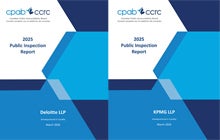
In its first release of individual inspection reports, CPAB published the findings for the Big Four accounting firms this past March. As reported by Canadian Accountant, the new reports identified that KPMG Canada had the highest rate of files with significant findings, while Deloitte Canada had the fewest.
“With public inspection reporting now underway, we’re entering a new era of greater transparency for investors, audit committee chairs and other stakeholders across Canada,” said Sonny Randhawa, CEO, CPAB. “We must build on this progress made and continue strengthening public trust and confidence in financial reporting.”
Audit quality continues to improve at mid-size Canadian firms
CPAB assessed 235 registered firms in 2025 (down from 242 in the previous year), 175 of which audited reporting issuers, a term for publicly traded companies on Canadian stock exchanges. Of these firms, the Big Four accounting firms increased their market dominance, auditing 92.5% of Canadian reporting issuers by market capitalization, up from 90.5% in 2024.
According to its annual report, CPAB inspected 120 audit files in 2024 and identified significant findings in 23% of files, as compared to 24% in 2024, and 34% in 2023. Of particular note, there was a decrease in findings at many smaller Canadian audit firms in 2025, when compared with the previous year.
There was a slight increase in significant findings at the Big Four: 10 of 62 files inspected, as compared to eight of 65 files inspected in 2024. It is worth noting, however, that in 2021, the Big Four had just seven significant findings out of 75 files overall.
The real improvement is occurring at the eight other annually inspected firms. These tend to be mid-size national and regional accounting firms such as BDO, Crowe, Doane Grant Thornton, MNP, and others. In 2021, CPAB found 22 significant findings in 41 files. Five years later, the results have dramatically improved, with four findings out of 31 files inspected.
With such improved audit quality, it is a wonder that the audit market dominance of the Big Four has continued to increase, as one might expect the mid-size accounting firms to gain new audit clients with higher market capitalizations.
Themes of the 2025 Annual Report
“Transparency, Technology and Trust in a Changing Landscape” details the increased use of artificial intelligence-enabled tools in the auditing profession. According to its annual report, CPAB itself is using generative AI tools, “to improve the efficiency and effectiveness of some of our processes.”
At a time when one of the Big Four firms confessed to using AI-generated false citations in its consulting report, CPAB is encouraging firms “to assess whether they have evolved their system of quality management to effectively manage firm-level and engagement-level risks.” In December 2025, CPAB published “The evolving use of technology in the audit,” which AI-related issues CPAB found in its inspections of firms.
One interesting theme of note is the dramatic decrease in audit issues related to the cannabis industry. In 2021, there were 13 significant findings overall, outstripping all other industries in the past five years, as a high-risk industry similar to cryptocurrency companies. In 2025, that figure fell to just two findings out of six files inspected.
As an organization, CPAB is in a strong fiscal position, reflective of the stewardship of its chief executive officer, Carol Paradine, who left the audit watchdog recently. The organization continues to run annual surpluses and is budgeting for a surplus of $40 thousand for 2026.
CPAB notes that the demand for professional resources continues to place pressure on salary and compensation costs. It appears that CPAB will be increasing its staffing as well. As noted recently by Canadian Accountant, the organization is recruiting for a position in its thought leadership team, and one additional resource to its enforcement team. The overall headcount is expected to increase by 10 people (71:81) for fiscal 2026.
Professional fees are budgeted to decrease from $472 thousand to $227 thousand. According to CPAB, “this is primarily due to decreased recruitment costs,” most likely in relation to its change in leadership roles, “partially offset by an increased use of consultants and specialists to support the inspection team in complex areas and to evaluate technology tools used in audits.”
Colin Ellis is a contributing editor to Canadian Accountant.






(0) Comments