

10 Canadian tax facts you ought to know
With the recent release of Canadian Tax Facts 2026 from David J Rotfleisch, now is the time to test your knowledge and assumptions about Canadian taxation
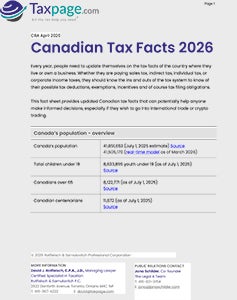 |
The almost 60-page “Canadian Tax Facts 2026” is a free download on the homepage of Taxpage.com. |
TORONTO, April 19, 2026 – As we quickly approach the end of tax season, how informed are you about the current state of Canadian taxation? With the recent release of Canadian Tax Facts 2026, now is the time to test your knowledge of business and personal tax rates, tax audit statistics, tax reassessments, cryptocurrency tax, information on trusts, voluntary disclosures, tax evasion and much more.
Canadian Tax Facts is published each year by Canadian tax lawyer and chartered professional accountant David J Rotfleisch. “Although the Auditor General’s Report was pretty scathing, CRA’s website now offers the GenAI chatbot and natural language search to help Canadian taxpayers get answers to their questions. That’s the good news,” said Rotfleisch.
“The bad news is: ‘GenAI chatbot responses are based on Canada.ca content but are not legal or professional advice. Information may not be 100% accurate; users should verify critical details with a professional or official CRA source’,” added Rotfleisch, quoting from CRA’s website.
Here are 10 fun facts about Canadian taxation that may test your assumptions and knowledge. Unless otherwise noted, source material can be accessed by downloading Canadian Tax Facts.
The average amount of tax paid per household by percentage has increased in the last 60 years.
The average amount of tax paid by a Canadian family in 2025 was $48,306 (a 42.3% tax bill), compared to a 33.5% tax bill in 1961. In reaching this number, the Fraser Institute included “income taxes, payroll taxes, health taxes, sales taxes, property taxes, fuel taxes, carbon taxes, vehicle taxes, import taxes, alcohol and tobacco taxes, and the list goes on.”
Very few people are convicted of tax evasion in Canada.
In 2024-2025 there were five convictions for $2.7 million evaded. From 2023 to 2024, there were 11 convictions for $13.3 million evaded. Once a criminal investigation case has been completed, it is referred by the Canada Revenue Agency, where appropriate, to the Public Prosecution Service of Canada (PPSC) for possible criminal prosecution.
Nine out of 10 Canadians file their tax returns electronically. The majority use EFILE.
There are 70 tax havens in the world, including the United States. Is Canada a tax haven?
Yes, according to the Panama Papers, released in 2017. “A sprawling international tax avoidance industry is increasingly touting Canada as a jurisdiction for hiding wealth,” known as "snow-washing."
How much do Canadian companies really pay in tax?
A 2022 report from Canadians for Tax Fairness says it analyzed the financial statements of 123 corporations worth at least $2 billion and found they paid $30 billion less in taxes in 2021 than would be expected under corporate tax rates—an effective or actual tax rate of about 15%.
How have the courts dealt with “detaxers?”
Unanimous rejection. Every Canadian court has rejected “Freemen on the Land” arguments as frivolous and "bluntly idiotic."
How does the CRA’s performance in tax collection compares with tax agencies in other countries?
Canada performs about average overall among advanced countries, with strong compliance and debt collection, but less efficient administrative costs compared to top-performing tax agencies.
How many chartered professional accountants work at CRA?
Based on recent estimates, only about 5-7% of CRA employees hold a chartered professional accountant designation, indicating roughly 2,624 to 3,674 CPAs.
How many CRA employees are disciplined or fired each year?
There were roughly 370 founded misconduct cases and about 25 employees fired (disciplinary terminations) in 2024–2025.
How much does a CRA employee make in a year?
The average salary for a CRA employee is approximately $75,365 per year. Salaries typically range from around $54,000 for clerical or entry-level positions to over $100,000 for management, with auditors averaging roughly $72,000–$76,000 annually. But the benefit and pension package is highly valued.
The almost 60-page “Canadian Tax Facts 2026” is a free download on the homepage of Taxpage.com. New this year are sections on “Detaxers” (page 31) and the Auditor General’s Report on CRA’s Performance in 2025 (page 36).
By Canadian Accountant with files from Taxpage.com. Title image: iStock ID 1298118430.








(0) Comments