
PCAOB inspection report: Almost half of PwC Canada audits included significant deficiencies
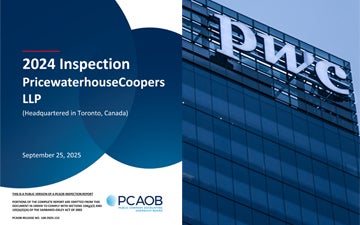
PricewaterhouseCoopers lowered its deficiency percentage from 63 to 43 per cent, according to US audit watchdog review of seven audits conducted in 2024
 |
Click here to download the PCAOB PwC Canada inspection report for 2024. |
TORONTO, Dec. 7, 2025 – The Public Company Accounting Oversight Board in the United States found deficiencies in almost half of the audits it inspected of PricewaterhouseCoopers in Canada. According to the latest inspection report from the PCAOB, the Canadian accounting firm lowered its deficiency rate from 63 to 43 per cent in two years, for the seven audits inspected by the US audit watchdog.
Under the Sarbanes-Oxley Act, registered firms outside the US are subject to PCAOB inspections in the same manner as US firms. Since the inception of the PCAOB's international inspection program in 2004, the PCAOB has conducted inspections of one or more registered firms located in more than 50 non-U.S. jurisdictions, including Canada.
In both 2024, PwC Canada was the principal auditor of 58 public companies (“issuer audit clients”), under the oversight of the PCAOB, and 25 companies for which it was not the principal auditor. Forty-nine partners at PwC Canada were engaged in issuer audit work.
Multiple deficiencies in three audits
The inspection report details multiple deficiencies in the audits of three companies. Issuer A is in the materials sector, a classic Canadian “hewers of wood” corporate sector, which includes forestry, mining, and chemical companies. Issuer B is in the energy sector. Issuer C is in the consumer staples sector.
According to the inspection report, the issue with the first company, which was involved in a “business combination,” centred around the various “significant” assumptions, including reserves and resources estimates, made by the issuer. PwC Canada did not identify and test any controls over the accuracy and completeness of the reserves and resources estimates, among other issues related to a technical report “prepared by external specialists engaged by the acquired company.”
The audit of the second company also involved issues related to the estimates of specialists retained by the issuer. “The issuer engaged specialists to estimate its oil and gas reserves (“reserve estimates”), which were then used in the (1) calculation of depreciation, depletion, and amortization and (2) impairment analysis of long-lived assets. The company’s specialists used financial and non-financial data and assumptions, deemed significant by the firm, to develop the reserve estimates in the reserve report.”
PwC Canada was not the principal auditor of the third company. According to the inspection report, the
Financial relationships between partners and issuers
The US audit watchdog continues to request that accounting firms self-identify areas where its independence may be compromised. In the case of PwC Canada, the most common issue was potential non-compliance related to financial relationships and employment relationships, specifically investments and other financial relationships in the companies being audited.
“Two of these financial relationships were instances where a partner in the same office as the engagement partner for an issuer had a financial relationship with that issuer. Two of these instances related to a member of an audit engagement team.”
PwC Canada: Auditor of large cap Canadian corporations
The four largest accounting firms (Deloitte, Ernst & Young, KPMG, and PwC) audit 90 per cent of public companies by market capitalization in Canada. These are typically corporations listed on the Toronto Stock Exchange — names familiar to many Canadians — that are also listed on American exchanges or whose stock can be purchased on over-the-counter markets.
In its response to the inspection report, the firm stated:
“Consistently performing high-quality audits remains the top priority of the Firm and our partners, in order to continue to serve the investing community and bring value to capital markets. We have evaluated the observations set forth in Part I: Inspection Observations and are taking appropriate responsive actions to comply with PCAOB standards and our own policies and procedures. We recognize it is important to acknowledge and address the matters in the Report in a thorough and thoughtful manner.”
Colin Ellis is a contributing editor to Canadian Accountant. Title image: iStock-637894300 and PCAOB inspection report.





(0) Comments